spnsLogo

SCOTTISH PLACE-NAME SOCIETY
COMANN AINMEAN-ÀITE NA H-ALBA

Biggar, South Lanarkshire

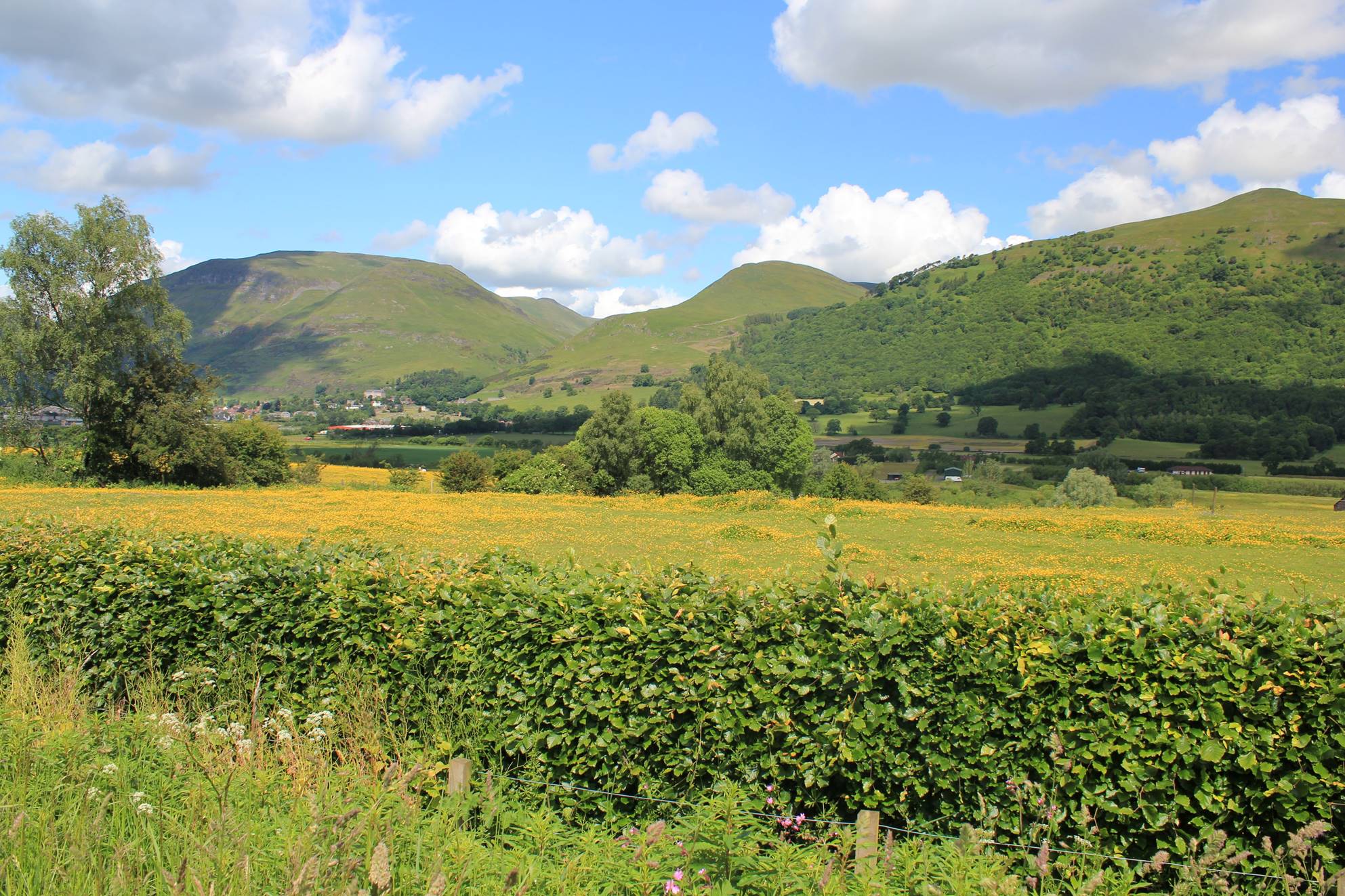
Just after dawn: north-eastward view from a balloon flight over the outskirts of Biggar, South Lanarkshire. After a very still, cool summer night, cold moist air had flowed down the hillsides and formed mist in the hollows and valleys. This well known meteorological phenomenon of hilly districts was invoked by W J Watson in his classic ‘The Celtic Place-Names of Scotland’, to explain the Naver of Sutherland, Nabar- in Roman times, Nabhair in Gaelic, as probably named for the fogs rising from the river. He saw the name as from an Indo-European root shared with Greek néphos, ‘cloud’, and Sanskrit , ‘wet cloud’. Beyond Broomy Law, with its group of telecom masts on the horizon, drainage converges on the Tarth Water, with its flat floodplain confined by hills. As a prime candidate for convection fogs, it is intriguing that its name, in Welsh, means ‘mist’; but Gordon’s 17th century map has ‘Terf’. As for the small town in the foreground, “Glasgow is big but Biggar is Biggar”, and more of a challenge to toponymists than the ‘Green Hollow’.

News :

Scottish Toponymy in Transition: Progressing County Surveys

Scottish Place-Name Society Spring Conference, Saturday 4rd May, Aberdeen


      about  ¦  resources
  links   ¦  search

last updated: 26 March 2012

Search the site:
PicoSearch

  Help

For discussion and queries about Scottish place-names, join the Scotplace discussion group
or go to twitter.com/Scotplacenames
Subscribe to scotplace

Powered by uk.groups.yahoo.com


This website and all the pages and information it contains is copyright © Scottish Place-Name Society 1995-2009.
Permission is granted to print pages from this website for personal use.
However, commercial publication, copying, hiring, lending and reproduction are strictly prohibited and constitute a breach of copyright.